
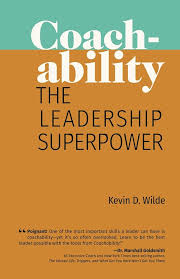
Though I’ve been a business coach for nearly 20 years, I remain an enthusiastic student; always striving to improve. Coach-ability caught my eye because its intended audience is the “coachee” (person being coached) as opposed to the coach (person doing the coaching). This book, subtitled The Leadership Superpower, by author and longtime corporate leadership guru Kevin Wilde, focuses on how to be more coachable…a perspective and approach rarely explored.
Instead of addressing the extremely common subject of How to Be a Better Coach, Wilde focuses on a person’s coachability. But he cautions not to define one’s level of coachability as their ability to be coached, for that’s too passive and may lull you into a false sense of complacency. The coachee needs to not only be active and engaged in the coaching but should take primary responsibility for the outcomes and benefits of the coaching.
Why is this so important? Wilde cites many reasons, including the benefits of a high-coachable leader and the risks of a low-coachable leader.
Benefits of a High-Coachable Leader Risks of a Low-Coachable Leader
| Overall leadership effectiveness rated higher
Higher levels of critical competencies, including innovation, inspiration, strategy, collaboration Greater employee engagement and retention Higher performance ratings and higher promotability rating Greater likelihood of investment support for entrepreneurial ventures |
Greater chances of developing and/or expanding blind spots
Premature career stalling or even derailment Stuck in old patterns of thinking and acting Loss of opportunities to acquire new skills and abilities Loss of influence and negative impact on others |
A study that Wilde cites compared the coaching skills of managers versus the coachability of the employees. The findings were that the coachability of the employee mattered more than the coaching skills of the managers for higher levels of performance, agility, development, and career potential. He writes that “While it’s good to have both, given a choice to train managers to be better coaches or employees to be more coachable, bet on the power of coachability.”
Wilde suggests three key factors in determining how coachable someone is:
- Actively looks for opportunities to get feedback and improve him/herself.
- More focus is given in business to delivering the message (feedback) than learning how to receive it well. Highly coachable leaders have specific practices they regularly employ to seek input and feedback from others.
- Makes a real effort to improve based on feedback from others.
- Low-coachable leaders are unsure what needs to change or how to go about changing. They look only for a quick fix that doesn’t require much thought or effort. They may have good intentions, but are easily distracted, have trouble following through, and tend to quickly fall back to old, comfortable habits.
- Creates an atmosphere of continual improvement in which self and others push to exceed the expected results.
- Maintaining a higher-level perspective in the midst of day-to-day action is a challenge, but it’s critical to continually step back and ask “What’s really going on here?” Highly coachable leaders help others understand and appreciate the value of continual learning and self-improvement.
Wilde writes that a coachable leader values self-improvement and operates consistently in a learning zone by applying the coachability practices of seek – respond – reflect – act, explaining that:
Value: Highly coachable leaders value self-improvement and growth. They value continual learning and confidently regard themselves as a work-in-progress.
Seek: Highly coachable leaders are intentional at regularly seeking input from others on how to improve. They signal that they welcome feedback and ideas for improvement at any time.
Respond: Whether incoming feedback is a result of asking for it or not, highly coachable leaders respond in an open way. They allow the message to be given uninterrupted and then probe to fully understand it. They show appreciation for the willingness of the other person to offer input.
Reflect: Highly coachable leaders separate the openness and curiosity while receiving feedback from the reflection and analysis of the message. They take the time to think if the feedback has merit and ways to use it to grow. They know they don’t have to act on everything they hear, but they will always pause and reflect.
Act: When deciding to act on feedback, highly coachable leaders start with a mindset of experimentation and achievement in small steps. Once momentum builds from early action, they apply sustainability strategies so a new behavior becomes habit.
Applying the coachability practices of seek – respond – reflect – act leads to Wilde’s Formula for Successful Change:
Accurate Awareness of What to Change X Sufficient Motivation and Self-Image X Applicable Knowledge, Skills, Tools X Sustained Effort
The author concludes that our short-term change needs to evolve to be a regular habit and that you can apply the habit-building approach to sustain your overall growth as a coachable leader. Being unclear, unmotivated, distracted, having unrealistic plans, or lacking critical abilities are factors causing us to not follow through successfully with improvement decisions.
I hope this book summary was of interest to you and that you found it helpful. If you have any questions about coachability or would like to take a coachability self-assessment, please contact me.